Boswellia rivae is one of Ethiopia’s distinctive frankincense-producing tree species. Its aromatic resin is used as frankincense and may also be described within the broader international trade terminology of olibanum or gum olibanum. In parts of eastern Ethiopia, Boswellia rivae and its resin are locally known as Mirafur.
The species is native to the drylands of Ethiopia, Somalia and northeastern Kenya and is particularly associated with the dry Acacia–Commiphora woodlands of eastern and southeastern Ethiopia. Although less internationally commercialized than species such as Boswellia papyrifera and Boswellia sacra, B. rivae is attracting interest because of its aromatic resin and distinctive essential-oil composition.
What Is Boswellia Rivae?
Boswellia rivae belongs to the Burseraceae family, which includes the trees responsible for producing frankincense and myrrh.
Like other frankincense-producing Boswellia species, B. rivae produces an aromatic oleo-gum-resin. This natural resin can be collected, cleaned and sorted for applications including incense and essential-oil distillation.
In eastern Ethiopia, researchers have documented the local name Mirafur for both the tree and its resin. Other vernacular names have also been recorded in Ethiopia, including Black Incense, Ye-Sidamo Etan Zaf, Matabut, Qura, Murfur-ad, Mohor-medu, Murken and Bayemedow, with terminology varying between languages and localities.
For international trade, the scientific name Boswellia rivae Engl. provides the clearest botanical identification.
Where Does Boswellia Rivae Grow?
Boswellia rivae is primarily a species of the drylands of the Horn of Africa.
Its natural distribution includes:
- Ethiopia
- Somalia
- Northeastern Kenya
Within Ethiopia, the species is particularly associated with eastern and southeastern drylands, including areas within the Somali Region and historically documented areas of Harerge, Bale and Sidamo.
The tree is adapted to hot and relatively dry environments and can occur in Acacia–Commiphora woodland, rocky terrain and areas with limestone, gypsum or sandy substrates.
This ecological adaptation distinguishes B. rivae from Boswellia papyrifera, which is much more strongly associated with the dry woodlands of northern and northwestern Ethiopia.
Mirafur: A Local Name for Boswellia Rivae
Mirafur is an important name associated with Boswellia rivae in eastern Ethiopia.
Field research conducted in Ethiopia documented Mirafur as the local name used for both the tree and its resin. This terminology can be useful for buyers trying to understand the relationship between locally traded resin and its botanical identity.
However, local names can vary considerably between communities. For export and technical documentation, it is therefore preferable to identify the product by its botanical name:
Botanical name: Boswellia rivae
Product: Natural frankincense oleo-gum-resin
Origin: Ethiopia
Chemical Composition of Boswellia Rivae
One of the most interesting characteristics of Boswellia rivae is its essential-oil composition.
Research on Ethiopian B. rivae resin has identified essential oils dominated by monoterpenes and oxygenated monoterpenoids. Important compounds reported from Ethiopian samples include:
- α-Pinene
- Limonene
- δ-3-Carene
- p-Cymene
- β-Pinene
- α-Thujene
- trans-Verbenol
- β-Phellandrene
- trans-Pinocarveol
- trans-β-Elemene
A study of eastern Ethiopian material reported considerable variation between samples.
| Major compound | Reported range |
|---|---|
| α-Pinene | 5.5–56.4% |
| Limonene | 1.8–37.3% |
| δ-3-Carene | 0.1–31.5% |
| p-Cymene | 1.4–31.2% |
| β-Pinene | 0.3–13.0% |
| α-Thujene | 0.1–12.4% |
| trans-Verbenol | 0.1–11.2% |
These figures represent published research results rather than guaranteed commercial specifications. Natural variation occurs between trees, locations, harvests and individual resin batches. Buyers requiring a specific chemical profile should therefore request batch-specific GC-MS analysis.
α-Pinene in Boswellia Rivae
α-Pinene is one of the important volatile compounds identified in Boswellia rivae essential oil.
In analyzed eastern Ethiopian samples, α-pinene ranged from approximately 5.5% to 56.4%, making it one of the major components observed in the species.
This contributes to an essential-oil profile quite different from that commonly reported for Ethiopian Boswellia papyrifera, whose essential oil can instead be strongly dominated by octyl acetate.
Limonene
Limonene is another important constituent reported in Boswellia rivae essential oil.
Research on Ethiopian samples found concentrations ranging from approximately 1.8% to 37.3%.
The presence of limonene together with α-pinene and other monoterpenes contributes to the complex aromatic character of the oil.
δ-3-Carene and p-Cymene
Researchers have also identified substantial concentrations of δ-3-carene and p-cymene in some Boswellia rivae samples.
In one Ethiopian study, δ-3-carene reached approximately 31.5%, while p-cymene reached approximately 31.2% in some samples.
The considerable variation between samples demonstrates why botanical identification alone does not guarantee a particular essential-oil composition.
Boswellia Rivae Essential Oil
Boswellia rivae resin can be processed through distillation to obtain frankincense essential oil.
Research on Ethiopian material has reported relatively substantial essential-oil yields in some samples. Individual tree samples examined in one study produced hydrodistillation yields of approximately 8.74%, 12.49% and 14.53% by weight.
These figures should not be treated as guaranteed production yields. Actual commercial yield may be affected by:
- Resin quality
- Resin age
- Geographic origin
- Storage conditions
- Moisture
- Distillation method
- Processing equipment
- Distillation time
For commercial essential-oil production, testing a representative sample before purchasing a large quantity is therefore advisable.
How Is Boswellia Rivae Resin Collected?
An interesting characteristic documented in eastern Ethiopia is the collection of naturally exuded resin.
Researchers studying Boswellia rivae found that the trees they observed were generally not intentionally tapped. Resin was instead collected after natural exudation, including exudation associated with natural damage to the tree.
This differs from some established frankincense production systems where collectors intentionally make repeated tapping incisions in the bark to stimulate resin production.
Collection practices may nevertheless differ between locations, so the harvesting method of a particular commercial supply should be verified at source.
What Is Boswellia Rivae Used For?
Natural Incense
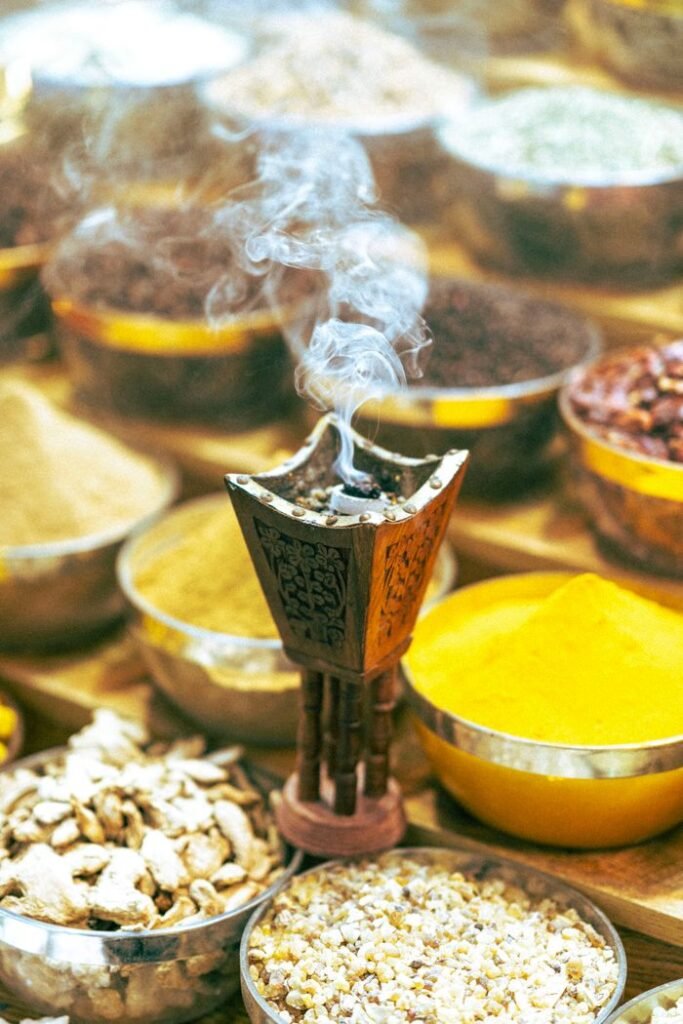
Like other frankincense resins, Boswellia rivae can be burned as natural aromatic incense.
When heated, the resin releases volatile aromatic compounds that produce its characteristic fragrance.
Essential-Oil Production
The resin can be distilled to produce Boswellia rivae essential oil.
Its monoterpene-rich profile makes it particularly interesting for buyers evaluating Ethiopian frankincense as a raw material for essential-oil production.
Perfumery and Fragrance
Frankincense and frankincense-derived essential oils have long been valued as aromatic materials.
The presence of compounds such as α-pinene, limonene, δ-3-carene and p-cymene gives B. rivae potential relevance to fragrance and perfumery applications.
Cosmetics and Personal Care
Frankincense-derived essential oils and extracts can also be incorporated into appropriately formulated cosmetic and personal-care products.
The requirements depend on the intended formulation and regulatory standards of the destination market.
Botanical Research and Processing
Because Boswellia rivae remains less extensively commercialized and studied than some better-known frankincense species, it is also of interest for phytochemical research, botanical analysis and natural-product development.
Boswellia Rivae vs Boswellia Papyrifera
Although both species occur in Ethiopia and produce frankincense, Boswellia rivae and Boswellia papyrifera are different botanical species.
Their geographical distribution and chemical characteristics also differ.
| Characteristic | Boswellia rivae | Boswellia papyrifera |
|---|---|---|
| Major Ethiopian distribution | Eastern and southeastern Ethiopia | Northern and northwestern Ethiopia |
| Important local/trade name | Mirafur | Tigray-type Olibanum |
| Notable essential-oil compounds | α-Pinene, limonene, δ-3-carene, p-cymene | Often dominated by octyl acetate |
| Commercialization | Relatively limited | More established |
| Main raw material | Oleo-gum-resin | Oleo-gum-resin |
These differences are particularly important for companies purchasing frankincense for essential-oil distillation, extraction, fragrance production or research.
Quality Considerations for Boswellia Rivae
International buyers purchasing Boswellia rivae may evaluate characteristics such as:
- Botanical identity
- Country and region of origin
- Appearance
- Tear size
- Aroma
- Moisture
- Foreign matter
- Purity
- Essential-oil yield
- GC-MS profile
- Collection method
- Storage conditions
Where chemical composition is commercially important, analysis should be conducted on the actual commercial batch.
Species Identification and Purity
Correct botanical identification is particularly important for Boswellia rivae.
Research examining the eastern Ethiopian supply chain found evidence that commercial B. rivae resin could be mixed with resin from Commiphora africana. Researchers also noted that differentiating mixtures solely from essential-oil chemistry may be challenging.
For buyers, this increases the importance of traceable sourcing, botanical identification, physical inspection and appropriate laboratory testing.
Documentation for International Buyers
Depending on the destination country, application and buyer requirements, commercial Boswellia rivae shipments may require documentation such as:
- Certificate of Analysis (COA)
- Technical Data Sheet (TDS)
- Safety Data Sheet (SDS/MSDS)
- Certificate of Origin
- Phytosanitary Certificate, where applicable
- Commercial Invoice
- Packing List
Additional laboratory testing can be arranged when a buyer requires parameters such as moisture, purity, foreign matter, essential-oil content or chemical composition.
Boswellia Rivae from Ethiopia
Ethiopia possesses significant botanical diversity within the genus Boswellia, and Boswellia rivae represents one of the country’s distinctive frankincense resources.
Its occurrence in the eastern and southeastern drylands, its traditional identity as Mirafur, and its diverse essential-oil chemistry differentiate it from Ethiopia’s better-known Boswellia papyrifera frankincense.
Research has suggested that greater development of the B. rivae resin sector could potentially create additional economic opportunities in producing communities, provided commercialization is accompanied by appropriate resource management and traceability.
Ethiopian Boswellia Rivae for International Buyers
Ethio Resins Export PLC works with Ethiopian natural resin supply chains to make the country’s frankincense resources accessible to international buyers.
For Boswellia rivae, particular attention is given to botanical identity, Ethiopian origin, cleaning, sorting, physical quality and buyer-specific requirements.
Depending on availability and buyer requirements, Boswellia rivae resin may be evaluated for applications including:
- Natural incense
- Essential-oil distillation
- Fragrance and perfumery
- Cosmetics and personal care
- Botanical processing
- Research and product development
Because Boswellia rivae is a natural botanical material, physical and chemical characteristics can vary between batches. Buyers requiring a specific essential-oil composition or processing performance should therefore evaluate a representative sample and batch-specific laboratory results before commercial-scale procurement.
Conclusion
Boswellia rivae is a distinctive frankincense-producing species native to Ethiopia and neighboring parts of the Horn of Africa.
Known as Mirafur in parts of eastern Ethiopia, the species produces an aromatic oleo-gum-resin with a chemically diverse essential-oil profile. Research on Ethiopian material has identified α-pinene, limonene, δ-3-carene, p-cymene, β-pinene and other volatile compounds as important constituents.
Its characteristics differentiate it from other Ethiopian frankincense species, particularly Boswellia papyrifera. These differences make accurate botanical identification, geographic traceability and batch-specific quality analysis particularly important for international buyers.
With appropriate sourcing, quality control and sustainable resource management, Ethiopian Boswellia rivae has potential as a raw material for natural incense, essential-oil production, fragrance, cosmetics and other botanical applications.