
Botanically, Boswellia papyrifera belongs to the Burseraceae, the botanical family containing the well-known frankincense and myrrh-producing trees. The species occurs naturally in parts of Ethiopia, Eritrea and Sudan, with extensive stands occurring across the dry woodlands of northern and northwestern Ethiopia.
Among Ethiopia’s important producing areas is Metema, where Boswellia papyrifera forms part of an established natural frankincense economy involving collectors, cooperatives, unions, processors, traders and exporters.
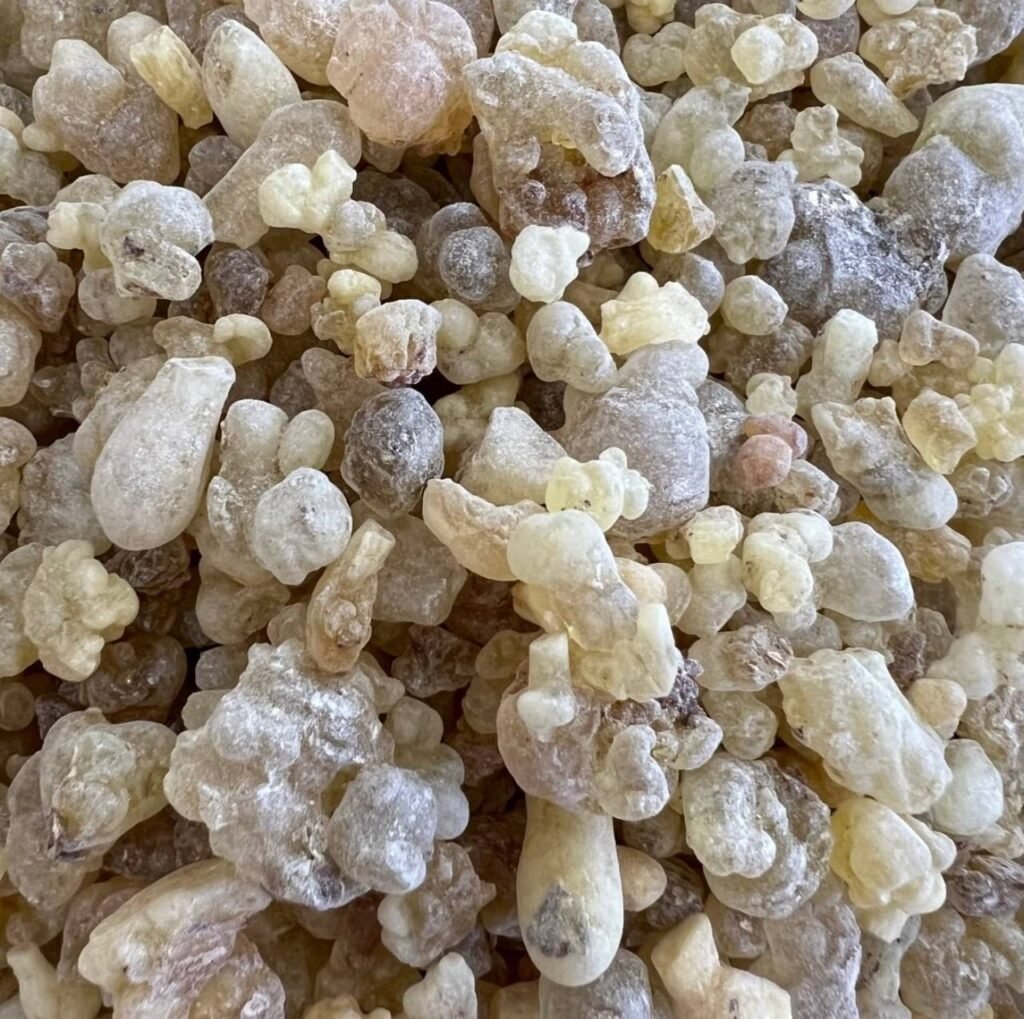
When the bark of the tree is carefully tapped, a milky aromatic substance is exuded. This material gradually dries and hardens into the characteristic natural tears commercially traded as Boswellia papyrifera frankincense resin or Gum Olibanum.
What Is Gum Olibanum?
The aromatic oleo-gum-resin obtained from Boswellia papyrifera is commercially known as frankincense or Gum Olibanum. In the Ethiopian and Northeast African frankincense trade, Boswellia papyrifera is an important botanical source of Gum Olibanum and is particularly associated with Tigray-type Olibanum (Tigray Frankincense).
The term Olibanum, however, is not botanically exclusive to Boswellia papyrifera. Internationally, it can also be used more broadly for frankincense obtained from other Boswellia species. For this reason, the designation Boswellia papyrifera Gum Olibanum provides greater botanical precision when describing Ethiopian Boswellia papyrifera resin.
Despite the word “gum,” Boswellia papyrifera frankincense is more accurately classified as an oleo-gum-resin because it naturally contains three principal fractions:
- A volatile or essential-oil fraction
- A water-soluble gum fraction
- An alcohol-soluble resin fraction
| Principal Fraction | Approximate Reported Proportion |
|---|---|
| Volatile oil | 3–8% |
| Alcohol-soluble resin | 60–70% |
| Water-soluble gum | 27–35% |
Published research on frankincense has reported these approximate proportions, although the exact composition varies according to species, geographic origin, individual tree, harvesting conditions, storage and analytical method.
Understanding these different fractions is important because frankincense used for incense burning, essential-oil distillation and botanical extraction can be evaluated according to very different chemical characteristics.
Chemical Composition of Boswellia Papyrifera
One of the most interesting characteristics of Boswellia papyrifera is its distinctive chemical composition.
Studies of Ethiopian B. papyrifera have identified volatile compounds, diterpenes, triterpenes, nortriterpenes and boswellic acids.
The chemical profile can vary considerably between trees and geographic origins, which is why commercial material intended for extraction or technical applications should ideally be supported by batch-specific laboratory analysis.
Octyl Acetate
One of the most characteristic compounds associated with Boswellia papyrifera essential oil is octyl acetate.
Research examining B. papyrifera resin collected from Metekel, Metema and Humera in Ethiopia found octyl acetate to be the dominant constituent of the analyzed essential oils.
| Ethiopian Origin | Reported Octyl Acetate |
|---|---|
| Metekel | 57.1% |
| Metema | 65.7% |
| Humera | 60.4% |
This unusually high octyl-acetate content helps distinguish the aromatic profile of Boswellia papyrifera from that of several other commercially traded Boswellia species.
Octyl acetate is an aromatic ester associated with fresh, fruity and citrus-like notes, contributing to the characteristic fragrance of the oil.
n-Octanol
Another notable volatile constituent is n-octanol. The same Ethiopian research reported approximately 3.4–8.8% n-octanol in the analyzed essential oils.
The combination of high octyl acetate and measurable n-octanol represents an important part of the characteristic volatile profile of Ethiopian Boswellia papyrifera.
Other Volatile Components
Research has also identified additional volatile compounds in Boswellia papyrifera essential oil, including:
- α-pinene
- Limonene
- Linalool
- Geraniol
The relative concentrations of these compounds can vary substantially among individual trees and geographic locations.
Boswellic Acids in Boswellia Papyrifera
The boswellic acids associated with frankincense occur primarily in the non-volatile resin fraction.
Boswellia papyrifera contains pentacyclic triterpenoid compounds, including boswellic acids. Research on the species has identified compounds including α-boswellic acid and related triterpenoids.
Important: Frankincense essential oil is not the same as a boswellic-acid-rich frankincense extract.
Essential oil represents the volatile compounds obtained primarily through processes such as steam or hydrodistillation.
Boswellic acids are substantially less volatile compounds associated with the resin fraction. Producing concentrated boswellic-acid extracts therefore requires appropriate extraction and processing rather than ordinary essential-oil distillation.
The precise boswellic-acid concentration of commercial resin should not be assumed from published literature. Where this parameter is important to a buyer, it should be established through laboratory analysis of the actual batch and reported on the Certificate of Analysis (COA).
Diterpenes, Triterpenes and Other Natural Compounds
The chemistry of Boswellia papyrifera extends beyond its essential oil and boswellic acids.
Phytochemical investigations have reported diterpenes including:
- Incensole
- Incensyl acetate
- Verticilla-4(20),7,11-triene
Triterpenes and nortriterpenes have also been reported. This chemical diversity has contributed to continued scientific and industrial interest in Boswellia papyrifera and other frankincense-producing species.
What Is Boswellia Papyrifera Used For?
The uses of Boswellia papyrifera range from one of humanity’s oldest aromatic traditions—burning frankincense—to modern essential-oil, fragrance and botanical-extraction industries.
1. Natural Incense
One of the oldest and most familiar uses of Gum Olibanum is burning the natural resin as incense.
When placed over hot charcoal or another suitable heat source, the resin releases its characteristic aromatic smoke.
Frankincense has a long history of religious, cultural and household use throughout Africa, the Middle East and other parts of the world.
In Ethiopia, Etan (እጣን) has particularly strong cultural significance and is commonly associated with religious practices, households and the traditional Ethiopian coffee ceremony.
For the incense market, buyers commonly evaluate:
- Tear size
- Colour
- Cleanliness
- Aroma
- Foreign-matter content
- Moisture
- Overall purity
Clean and carefully sorted natural tears are generally preferred for premium incense applications.
2. Frankincense Essential Oil
Boswellia papyrifera resin can be distilled to produce frankincense essential oil.
The octyl-acetate-rich profile of Ethiopian B. papyrifera makes its essential oil chemically different from oils obtained from several other frankincense-producing species.
Essential oil producers may evaluate raw frankincense according to:
- Essential-oil yield
- Geographic origin
- Freshness
- Storage conditions
- GC-MS chemical composition
3. Botanical and Boswellic-Acid Extraction
The non-volatile resin fraction makes Boswellia papyrifera relevant to companies producing botanical extracts and researching boswellic acids and related triterpenoids.
For extraction applications, buyers may require considerably more detailed chemical analysis than buyers purchasing resin for incense.
A representative sample can therefore be tested before a large commercial order to establish whether the material meets the processor’s extraction requirements.
4. Perfumery and Fragrance
Frankincense has been valued as an aromatic material for centuries and remains relevant to the modern perfumery and fragrance industry.
Depending on the formulation, manufacturers may work with natural resin, essential oil, extracts or other processed frankincense-derived ingredients.
The high proportion of octyl acetate reported in Ethiopian B. papyrifera essential oil contributes to its distinctive aromatic character.
5. Cosmetics and Personal Care
Frankincense-derived materials are also incorporated into some cosmetic and personal-care formulations.
Applications depend on whether the manufacturer requires essential oil, extract or another processed derivative rather than simply the raw resin.
Manufacturers must formulate according to the applicable cosmetic, safety and regulatory requirements of their target market.
6. Traditional Uses
Frankincense has an extensive history of traditional use in Ethiopia and throughout the wider region.
Traditional applications described in ethnobotanical literature should, however, be distinguished from clinically established medical indications. Scientific investigation into frankincense constituents continues, but traditional use alone should not be interpreted as proof that a product treats or prevents a particular disease.
Boswellia Papyrifera in Ethiopia
Ethiopia is an important natural source of Boswellia papyrifera.
The species grows particularly well in dry woodland ecosystems of northern and northwestern Ethiopia, where frankincense collection provides an important natural-resource livelihood.
Major producing landscapes include areas of Amhara and Tigray, with Metema being particularly well known for commercial frankincense production.
The supply chain can involve:
Collectors → Cooperatives → Cooperative Unions → Traders/Processors → Exporters → International Buyers
Responsible management of these natural woodland resources is particularly important because commercial frankincense production ultimately depends upon maintaining healthy Boswellia populations and allowing adequate regeneration.
Metema Boswellia Papyrifera Frankincense
Metema frankincense is particularly relevant to the Ethiopian Boswellia papyrifera trade.
Metema is located in northwestern Ethiopia and contains extensive dry woodland resources associated with B. papyrifera. Research conducted on Ethiopian frankincense has included resin originating from this area.
One chemical study found the essential oil from the analyzed Metema B. papyrifera material contained approximately 65.7% octyl acetate, demonstrating the distinctive aromatic chemistry that can occur in frankincense originating from this region.
Note: Natural variation between individual trees means the 65.7% research value should not automatically be treated as the specification of every Metema shipment. Commercial buyers requiring a particular chemical composition should request analysis of the individual batch.
Understanding Frankincense Grades
Frankincense quality is not determined by a single characteristic. Depending upon the intended application, buyers may evaluate:
- Botanical species
- Geographic origin
- Tear size
- Colour
- Aroma
- Moisture content
- Foreign matter
- Cleanliness
- Purity
- Essential-oil content
- Chemical profile
- Extraction characteristics
Large, clean and carefully sorted tears may command particular interest in the incense market, whereas an extraction company may care considerably more about the chemical characteristics of the resin.
The intended application should therefore determine the appropriate specification.
Quality Testing and Documentation
International buyers of bulk Ethiopian frankincense may request laboratory and export documentation.
Depending on the destination, buyer and intended application, documentation may include:
- Certificate of Analysis (COA)
- Technical Data Sheet (TDS)
- Safety Data Sheet (SDS/MSDS)
- Certificate of Origin
- Phytosanitary Certificate, where required
- Commercial Invoice
- Packing List
Laboratory testing can also examine parameters such as:
- Moisture
- Ash
- Foreign matter
- Purity
- Essential-oil content
- Heavy metals
- Microbiological parameters where relevant
- Specific chemical constituents requested by the buyer
For extraction applications, more specialized analysis such as GC-MS, HPLC or other validated analytical techniques may be requested.
Other Names and Local Names of Boswellia Papyrifera
Because Boswellia papyrifera occurs across different countries and linguistic regions, numerous names have been associated with the tree and its resin.
International and Trade Names
- Frankincense
- Olibanum
- Gum Olibanum
- Frankincense Resin
- Frankincense Gum Resin
- Ethiopian Frankincense
- Tigray Frankincense
- Tigray Olibanum
- Tigray-type Olibanum
- Sudanese Frankincense
Ethiopian and Regional Vernacular Names
- Kerere / Kerari
- Yetan-zaf / Ye-Tigre Etan Zaf
- Kafal / Gafal
- Libanat
- Meqer / Meger
- Walba
- Dankwa
- Galgalem
- Fatuka
- Walia Meker
- Rutrut / Rut Rut
- Taragtarag / Tarak Tarak
- Durrto
Spellings can vary because many of these names have been transliterated from local languages into Latin characters.
These vernacular names should not be confused with botanical identification. For international commercial transactions, the scientific designation Boswellia papyrifera provides considerably greater precision.
Boswellia Papyrifera vs Other Frankincense Species
Frankincense is not produced by a single tree species.
The genus Boswellia contains several resin-producing species traded internationally, including:
- Boswellia papyrifera
- Boswellia sacra
- Boswellia carteri
- Boswellia frereana
- Boswellia neglecta
- Boswellia rivae
- Boswellia ogadensis
These species should not automatically be treated as interchangeable.
They can differ in appearance, aroma, essential-oil chemistry, resin composition, geographic distribution and traditional or industrial applications.
For this reason, international buyers purchasing frankincense for technical applications should establish the botanical species, rather than relying only on the general commercial name “frankincense.”
Ethiopian Boswellia Papyrifera for International Buyers
Ethiopia’s natural Boswellia papyrifera resources make the country an important origin for frankincense resin, Gum Olibanum and raw botanical material.
Ethio Resins Export PLC works within Ethiopian natural-resin supply chains to connect locally sourced frankincense with international buyers.
Our product portfolio includes Ethiopian Boswellia papyrifera frankincense, including material sourced from established producing regions such as Metema, subject to seasonal availability and individual buyer specifications.
The resin can be prepared according to requirements concerning sorting, cleaning, tear size, grade and packaging, while appropriate product and export documentation can be arranged according to the destination and transaction requirements.
Potential applications include:
- Natural incense
- Essential-oil distillation
- Botanical extraction
- Fragrance and perfumery
- Cosmetic and personal-care manufacturing
- Research and industrial processing
For industrial buyers, samples and batch-specific technical information can be used to evaluate the resin before commercial-volume procurement.
Because Boswellia papyrifera is a natural product, chemical composition can vary between harvests, individual trees and geographic origins. Where a specific chemical parameter is commercially important, the value should therefore be verified through analysis of the actual shipment batch rather than assumed from published literature.
Conclusion
Boswellia papyrifera, internationally traded as Ethiopian Frankincense, Gum Olibanum, Olibanum and Tigray-type Olibanum, is one of Ethiopia’s most important natural aromatic resin resources.
Its value extends well beyond its ancient role as incense. The resin contains a complex mixture of volatile aromatic compounds, resin acids, diterpenes, triterpenes and other natural constituents.
Particularly notable is the octyl-acetate-rich essential-oil profile reported from Ethiopian Boswellia papyrifera, including material collected from Metema.
Today, Boswellia papyrifera serves traditional incense markets while also providing raw material for essential-oil distillation, botanical extraction, perfumery, fragrance, cosmetics, research and other industrial applications.
For international buyers, understanding the botanical species, geographic origin, physical quality and batch-specific chemical composition is essential when selecting Ethiopian frankincense for a particular application.