
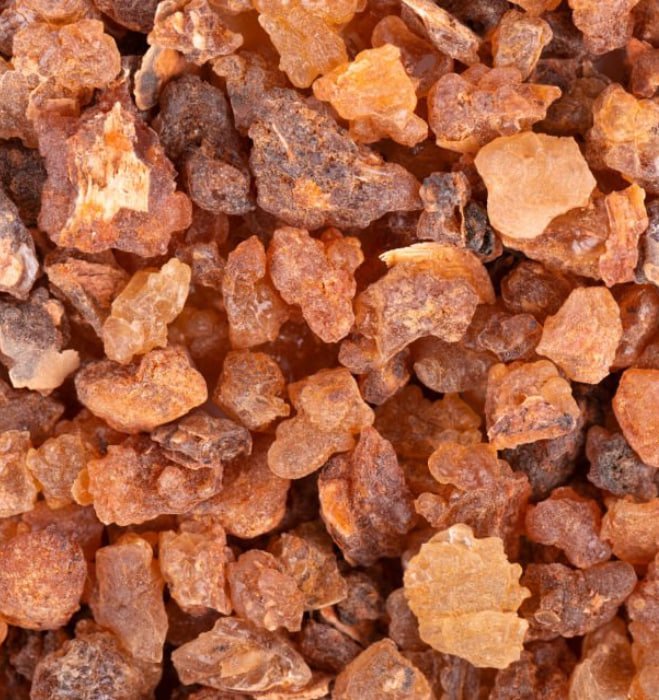
What is myrrh?
Myrrh is a natural oleo-gum-resin that seeps from the bark of small, thorny trees in the genus Commiphora, part of the Burseraceae family, the same family that gives us frankincense. The finest grade, often called “true myrrh,” comes from Commiphora myrrha, a tree that grows wild in the drylands of the Horn of Africa and southern Arabia, including Ethiopia’s Somali Region.
The name itself tells you what to expect. It comes from the Semitic root m-r-r, meaning “bitter,” shared by Amharic, Arabic, Hebrew and Aramaic. For more than 3,000 years myrrh has been traded for incense, perfume, medicine and embalming. Today it remains a valued raw material for fragrance, oral-care, cosmetic and natural-health manufacturers around the world.
Ethiopia sits at the heart of the myrrh belt. Its eastern lowlands hold natural stands of the most prized myrrh species, harvested by pastoral communities who have tapped these trees for generations. This guide explains what myrrh is, which species produce it, and what buyers should know when sourcing Ethiopian myrrh.
How myrrh is produced
Myrrh is harvested by wounding the tree’s bark and letting the sap bleed out. Collectors make small cuts in the trunk and branches with a traditional tapping tool (known locally as a mangaab) or a small axe. They also gather resin that oozes naturally from wounds made by browsing animals.
The fresh exudate is a pale, waxy liquid that coagulates quickly. Over several days it hardens into glossy “tears” that range from yellow to reddish-brown. As it ages, myrrh darkens and can show whitish streaks. Collectors return to the same trees to gather the dried tears, which are then cleaned and sorted by hand.
Myrrh is called an oleo-gum-resin because it combines three fractions:
| Fraction | Typical share | What it contributes |
|---|---|---|
| Water-soluble gum | 30–60% | Polysaccharides and proteins; gives myrrh its gummy texture and lets it form emulsions in water |
| Alcohol-soluble resin | 25–40% | Resin acids and triterpenes; the fraction extracted into tinctures and resinoids |
| Volatile (essential) oil | 2–10% | Sesquiterpenes that carry myrrh’s warm, balsamic, slightly medicinal scent |
This mix is why the same raw myrrh can be sold as incense tears, steam-distilled into essential oil, or solvent-extracted into resinoids for perfumery.
Responsible tapping matters. Research from the Horn of Africa links overly deep or frequent cuts to lower seed production, poor germination and declining tree populations. Sustainable harvesters limit the number and depth of wounds and rest trees between seasons.
The Commiphora species that produce myrrh
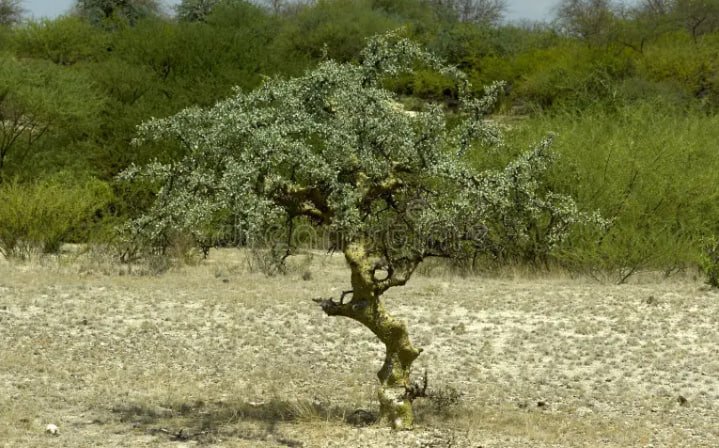
Several Commiphora species yield myrrh, but Commiphora myrrha is the recognized source of true, top-grade myrrh. The others produce resins that are traded as myrrh or blended with it, usually at lower grades and prices.
Commiphora myrrha (Nees) Engl. — true myrrh
- Synonyms and local names: C. molmol; known as malmal in Somali
- Form: A sturdy, spiny shrub or small tree up to about 4 m tall, with a short distinct trunk and silvery-grey bark that peels in papery flakes
- Leaves: Small, trifoliate and highly variable (about 6–44 mm long)
- Habitat: Open Acacia–Commiphora bushland on shallow soils, mostly over limestone
- Range: Ethiopia (Somali Region), Somalia, Kenya, Djibouti, Eritrea, Yemen, Oman and Saudi Arabia
- Resin: Hard, translucent, yellowish to reddish-brown tears with a bitter taste and a rich, warm aroma
The highest-quality natural stands are concentrated in the Ogaden area of eastern Ethiopia, Somalia and north-eastern Kenya.
Other myrrh-producing species
| Species | Notes |
|---|---|
| Commiphora habessinica (syn. C. abyssinica) | “Abyssinian myrrh”; widespread in Ethiopia and Yemen; one of the botanical sources named in pharmacological references |
| Commiphora guidottii (syn. C. hadi) | Scented myrrh or opopanax; see the next section |
| Commiphora erythraea | Eastern Africa and Arabia; also traded as a form of opopanax |
| Commiphora schimperi | Shrub of Ethiopian and East African drylands; minor myrrh source |
| Commiphora africana | Widespread African species; its resin is often called African bdellium |
| Commiphora gileadensis | “Balm of Gilead”; Arabian Peninsula and Red Sea coasts |
| C. foliacea, C. holtziana, C. playfairii, C. serrulata, C. quadricincta, C. truncata, C. hodai | Minor or regional sources of lower-grade myrrh |
For buyers, the key point is simple: always ask which species a lot comes from. Aroma, oil content and price vary significantly between species.
Myrrh vs. opopanax (scented myrrh) vs. bdellium
These three resins look alike and are often confused, but they come from different trees and smell different.
| True myrrh | Opopanax (scented myrrh) | Bdellium | |
|---|---|---|---|
| Main species | Commiphora myrrha | Commiphora guidottii (also C. erythraea) | Commiphora africana and related species |
| Local names | Malmal | Hagar, hadi, habak hadi; also “bisabol” | Varies by region |
| Aroma | Warm, bitter, balsamic, slightly medicinal | Sweeter, softer, honeyed and powdery | Weaker, less refined |
| Main uses | Incense, essential oil, tinctures, oral care, pharma | Perfumery (fixative and oriental notes), incense | Incense, lower-grade blends |
| Ethiopian origin | Somali Region (Ogaden) | Ogaden area of eastern Ethiopia, bordering Somalia | Various dryland areas |
C. guidottii is listed as Vulnerable because of over-harvesting, cutting for charcoal and climate stress, and it is described as rare within Ethiopia. Traceable, responsible sourcing is therefore especially important for opopanax.
Myrrh in Ethiopia
Ethiopia is one of the few countries where true myrrh (C. myrrha) grows naturally, alongside opopanax and frankincense. The trees grow in the semi-arid Acacia–Commiphora woodlands of the eastern and south-eastern lowlands, especially the Somali Regional State, where rainfall is low and soils are shallow and rocky.
- Who harvests: Pastoral and agro-pastoral families collect myrrh alongside livestock herding. Studies from the Somali Regional State show that myrrh and opopanax income helps these households buy food during dry seasons.
- Scale: Between 1998 and 2007, Ethiopia exported roughly 3,000 tonnes of aromatic resins (myrrh, opopanax and frankincense combined).
- Value to communities: Across the Horn of Africa, resin-producing households earn an average of about US$350 a year from resin sales, a meaningful share of income in dryland areas.
- Conservation: Tree cutting, poor tapping and low natural regeneration threaten wild stands. Buying from exporters who work directly with harvesting communities supports fair pay and better tapping practices.
Ethiopian myrrh is wild-harvested, not plantation-grown. Every lot reflects the land and the people who collected it.
Chemistry and quality
Myrrh’s scent and much of its biological activity come from furanosesquiterpenes in the essential oil. The most studied are:
- Curzerene and furanoeudesma-1,3-diene — the signature compounds of C. myrrha oil, shown in laboratory studies to act on opioid receptors, which may explain myrrh’s traditional use for pain
- Lindestrene — another characteristic sesquiterpene used as a marker in standardized extracts
- Resin acids and triterpenes in the alcohol-soluble fraction
When assessing a lot of raw myrrh, buyers typically look at:
- Species and origin — true C. myrrha commands the highest price
- Tear size and colour — larger, cleaner, translucent reddish-brown tears are graded higher than small pieces, dust or siftings
- Impurities — bark, sand and foreign matter should be minimal after hand-sorting
- Aroma and oil yield — fresh, well-stored myrrh gives a stronger scent and better distillation yield
- Moisture and storage — dry, ventilated storage prevents clumping and loss of volatile oil
Ask your supplier for a specification sheet and, for pharmaceutical or cosmetic use, a certificate of analysis.
Uses of myrrh
Myrrh has been used for thousands of years, from ancient Egyptian temple rites and embalming to its biblical role as one of the gifts of the Magi. Today its main markets are:
- Incense and religious use — burned alone or blended with frankincense in churches, mosques and homes, including in Ethiopian Orthodox tradition
- Perfumery — myrrh essential oil and resinoids add warm, balsamic base notes and act as fixatives
- Oral care — myrrh tinctures are a common ingredient in mouthwashes, toothpastes and gum-care products
- Cosmetics and skincare — creams, balms and soaps
- Food and beverage flavouring — the US FDA lists myrrh as generally recognized as safe (GRAS) for use in food
- Traditional medicine — used as an antiseptic, anti-inflammatory and for wound care; modern studies support some of these effects, though clinical evidence is still limited
Myrrh products for health use should always follow the rules of the market where they are sold.
Source Ethiopian myrrh from Ethio Resins Export
Ethio Resins Export supplies natural myrrh sourced from the Ethiopian lowlands, cleaned and hand-sorted for international buyers. We work with harvesting communities to deliver consistent, traceable lots for incense makers, distillers, perfumers and cosmetic and pharmaceutical manufacturers.
- Products: True myrrh (Commiphora myrrha), opopanax, and related natural resins
- Grades: Grade 1 large tears
- Packing:25 kg / 50 kg bags or cartons
- Documents: certificate of origin, phytosanitary certificate, TDS, SDS, COA on request
Frequently asked questions about myrrh
What tree does myrrh come from? Myrrh comes from trees of the genus Commiphora. True myrrh comes from Commiphora myrrha, a spiny shrub or small tree of the Horn of Africa and southern Arabia.
Is myrrh the same as frankincense? No. Both come from the Burseraceae family, but frankincense comes from Boswellia trees and myrrh from Commiphora trees. They are often traded and burned together.
Where does the best myrrh come from? The most valued myrrh comes from C. myrrha growing in eastern Ethiopia (Somali Region), Somalia and north-eastern Kenya.
What is the difference between myrrh and opopanax? Opopanax, or scented myrrh, comes mainly from Commiphora guidottii. It smells sweeter and softer than true myrrh and is prized in perfumery.
What is myrrh made of? Myrrh is an oleo-gum-resin: about 30–60% water-soluble gum, 25–40% alcohol-soluble resin and 2–10% essential oil.
How is myrrh harvested? Collectors cut the bark, let the sap bleed out and harden into tears, then gather, clean and sort the dried resin by hand.
https://www.linkedin.com/company/144943014